Is Maresias Beach Safe to Swim? How to Check CETESB
By MaresiasTur · · Updated on · 4 min read
Quick answer
To find out if Maresias Beach is safe to swim, check CETESB's weekly bulletin, published on Thursdays on the agency's website and app. On the sand, a green flag means the beach is safe and a red flag means it isn't.
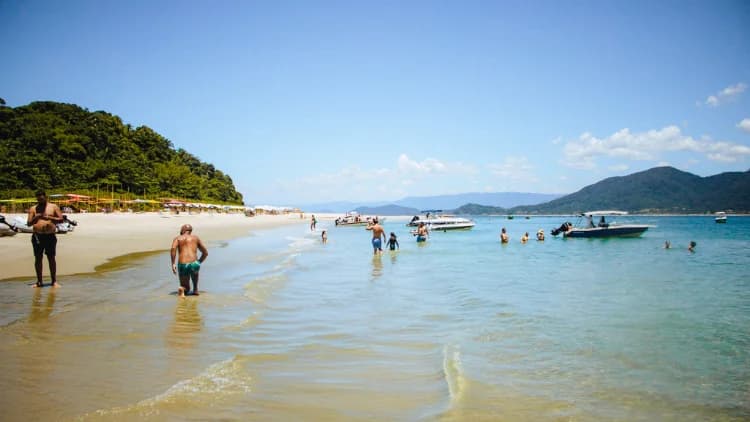
To find out if Maresias Beach is safe to swim, the official source is CETESB, São Paulo State's environmental agency. It collects water samples every week and releases the result on Thursdays, on the agency's website and free app. At monitored beaches, the flags are also swapped: green for a safe beach and red for unsafe.
Since the condition changes from week to week, this guide doesn't say how the beach is today. It explains how to check the bulletin, what the classifications mean, and which points are monitored in Maresias and neighboring beaches. The information was checked in September 2026 in CETESB's Coastal Beach Water Quality report, with 2024 data, and in the agency's official publications.
How do you check whether Maresias Beach is safe?
- Open the week's bulletin. It comes out on Thursdays on CETESB's website and free app, for Android and iOS, according to CETESB's blog.
- Or use the map. The beach water quality map shows the monitored points and each one's classification.
- Find the right point. In São Sebastião, Maresias appears at two points: Maresias and Maresias – Trav. XV. Each one has its own result.
- Check the date. The result applies to that week's samples. If you're reading it on a different day, check whether a newer bulletin has already come out.
- On the sand, watch the flag. Green means the beach is safe; red means it isn't.
Which points does CETESB monitor in Maresias and nearby?
The 2024 monitoring network had 175 points at 158 beaches in 15 municipalities along the São Paulo coast; the North Coast alone had 98 points at 91 beaches. Maresias has two sampling points, and the South Coast of São Sebastião has several others, which helps travelers compare before choosing the day's beach:
- Near Maresias: Paúba, Santiago, Toque-Toque Pequeno, Toque-Toque Grande, and Boiçucanga.
- Further south: Camburizinho, Camburi, Baleia, Saí, Preta, Juqueí (with two points), Una, Engenho, Juréia do Norte, and Boracéia.
- North Coast: the beaches on the municipality's north side also appear in the bulletin.
Travelers planning their itinerary in the region can find more ideas in the complete guide to what to do in Maresias.
What do the "safe" and "unsafe" classifications mean?
CETESB follows CONAMA Resolution No. 274/2000. The indicator used is the enterococcus bacteria, measured in colony-forming units (CFU) per 100 mL of water, based on the last five weekly samples. A beach is rated Safe, with three subcategories, or Unsafe:
| Classification | Criterion (enterococcus) |
|---|---|
| Safe – Excellent | Up to 25 CFU/100 mL in 80% or more of the 5 samples |
| Safe – Very Good | Up to 50 CFU/100 mL in 80% or more of the 5 samples |
| Safe – Satisfactory | Up to 100 CFU/100 mL in 80% or more of the 5 samples |
| Unsafe | 2 or more of the last 5 samples above 100 CFU/100 mL, or the latest one above 400 CFU/100 mL |
Sampling is weekly at most points (monthly at a few). The bulletin is sent to the press, city governments, and environmental agencies, published on CETESB's website, and communicated at the beach through the flags.
How do you read CETESB's flag at the beach?
The flag is the fastest way to know the classification without opening your phone. Green means the beach is safe to swim; red means it isn't. They're swapped according to the weekly bulletin, so they show the result of the most recent samples, not a measurement taken at that moment. When the stretch of beach you're on is far from the flag, it's worth checking the bulletin for which point matches the spot where you'll enter the water.
How did São Sebastião's beaches do in the latest annual report?
Besides the weekly bulletin, CETESB also produces an annual classification for each beach, on five levels: Excellent, Good, Fair, Poor, and Very Poor. In the report with 2024 data, São Sebastião was one of four municipalities on the São Paulo coast with beaches in the annual Excellent category. The annual classification shows the historical trend, but it doesn't replace the weekly bulletin when deciding whether to swim.
Where can you swim in clear water near Maresias?
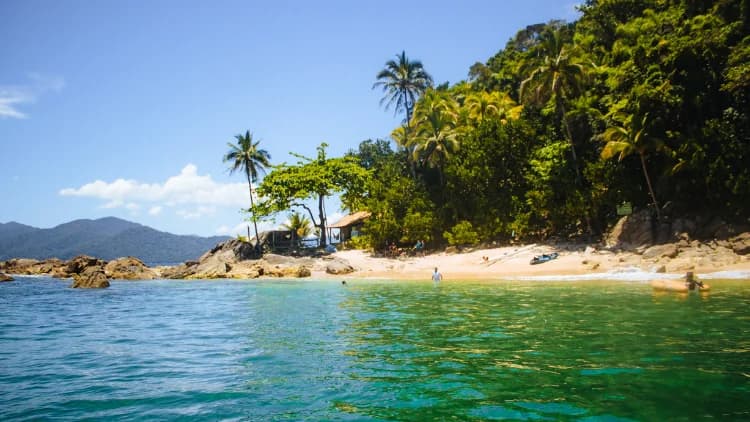
One way to see another side of the South Coast is by boat to the islands. The shared boat tour to the 3 Islands of the South Coast departs from Boiçucanga Beach at 9 am, noon, or 3 pm, and passes by Ilha das Couves, Ilha dos Gatos, and As Ilhas. It's about 3 hours long, with two stops for swimming and snorkeling in crystal-clear water, a licensed skipper, safety equipment, and pool noodles.
To learn about the destinations beforehand, read about Ilha das Couves in São Sebastião and the tips on snorkeling in São Sebastião. And to choose the month for your trip, see the best time for tours in Maresias.
Frequently asked questions
- Is Maresias Beach safe to swim today?
- It depends on the week's bulletin, because the condition changes from week to week. Check CETESB's latest bulletin on the website, the app, or the beach water quality map.
- When does CETESB's bathing water bulletin come out?
- On Thursdays, on CETESB's website and free app, and the flags on the beaches are swapped according to the result.
- What does CETESB's red flag mean?
- It means the point is unsafe for swimming: two or more of the last five samples exceeded 100 CFU of enterococcus per 100 mL, or the latest one exceeded 400.
- How many monitoring points does Maresias have?
- Two: Maresias and Maresias – Trav. XV. Each one appears with its own result in the bulletin.
- What does CETESB test for in seawater?
- The enterococcus bacteria, following CONAMA Resolution No. 274/2000. The classification considers the last five weekly samples at each point.